



Resort & Activity Information
WELCOME TO Sunrise Ridge waterfront resort
Dear Guest,
Welcome and thank you for choosing Sunrise Ridge Waterfront Resort for your holiday or business destination. We hope that our hospitable staff, the natural beauty of our resort, and the surrounding areas will provide you with a truly unforgettable experience.
It is our wish that while you are here, you find the true meaning of relaxation. Our team of staff is dedicated to making your visit as enjoyable as possible and we look forward to assisting you in any way they can.
The following pages contain information that may be useful to you during your stay at our resort and in the Oceanside area.
Please take a moment to browse through our guest directory by using the tabs on the left. For more information on Sunrise Ridge Waterfront Resort and seasonal packages and promotions, explore our website by clicking here. Should we be missing the information you are looking for, please be sure to dial “0” on your phone, and our guest services agents will do their utmost to find the information for you.
Thank you, we sincerely hope you have a wonderful stay!

RESORT & ACTIVITY INFORMATION
GUEST SERVICES
SUNRISE RIDGE WATERFRONT RESORT IS LOCATED AT:
1175 Resort Drive, Parksville, BC V9P 2E3
HOURS OF OPERATION
Front Desk: 24 hours a day, 7 days a week
CHECK OUT TIME
Check-out time is 10:00am. Please ensure you have gathered your belongings before leaving your suite. Late check-outs are based on availability and can be requested at reception or by dialing “0” on your in-room phone.
BAGGAGE STORAGE
Baggage storage is complimentary and is available at the front desk.
DVD
There are a number of DVD’s available for rent at the front desk for your enjoyment.
FIREPLACES
If you have a fireplace in your room, push “on” once for flame only, twice to add fan and three times to add heat. Building 400 units have gas fireplaces, operated from a light switch on the wall.
AIR JETTED TUBS
If you have an air jetted tub in your room, push the button once to start jets, and again to turn them off. The tub will come on again automatically about 20 mins after it is drained, in order to clean the jets. Please do not touch the button when this happens, it will turn off automatically when done.
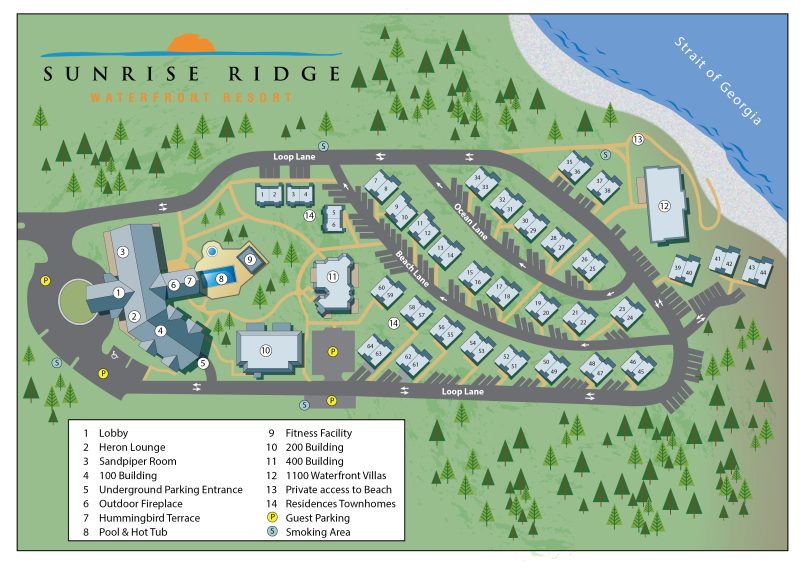
RESORT MAP
POLICIES
QUIET TIME
Quiet time is in effect from 11pm to 7am. Should you have a problem with a noisy neighbor, please be sure to let us know immediately. Dial “0” on your phone and the problem will be dealt with as quickly as possible. Please do not lose sleep. Guests exhibiting disruptive behavior or causing noise complaints during quite time will be held liable for damages and may be asked to leave.
NO SMOKING POLICY
Smoking of any kind – which includes tobacco products, vaping and cannabis – is restricted to outdoor designated smoking areas ONLY. Smoking of any kind of the deck of your vacation home is NOT permitted. A charge of $250 will be incurred if you are discovered smoking in one of the vacation rental suites.
PETS
Our Resort offers a limited number of suites that are designated as pet-friendly. Please note that guests who do not request a pet-friendly suite upon booking cannot be guaranteed one will be available upon arrival. Guests who bring pets into unauthorized suites may face a charge of $500 to deep clean the accommodation following their stay.
HOUSEKEEPING
Your suite is only cleaned upon departure. Daily housekeeping is available for an additional fee and is required to be pre-booked 72 hours in advance. Please ask our reservation agents for more information.
ROOM DEFICIENCIES
If you should encounter a problem with your room or are missing any amenities, please contact Guests Services as soon as possible. We will take every measure possible to ensure this is looked after as quickly as possible and to the best of our ability.
RESORT AMENITIES
Our outdoor pool is open May through October. The hot tub, fitness facility, meeting room and lounge are open year-round.
WI-FI INFORMATION
To connect to Sunrise Ridge Resort’s Wi-Fi network, open your device’s wireless connection utility. The “Sunrise Premium” page will automatically pop up, if not then select a browser and try reloading.
The first web page you will see requires you to enter a voucher “passcode”. If you do not see this page please try to go another webpage as your browser may be catching its start or opening page. Please enter the code into the box provided on the Sunrise Ridge portal web page. Click the Enter button.
If you not have a voucher “passcode” please contact the front desk.
Please keep your voucher handy as you may be requested to enter it again at some point in the future. This may occur if you move far enough away from your current Wi-Fi node and connect to a new node within the facility.
If your passcode say “expired” or “not found” please contact the front desk to confirm code or to renew it or get a new one.
TROUBLESHOOTING
Many Wi-Fi issues can be resolved by doing the following:
Note: If you have more than one device, check to see if the other device can connect properly to the Wi-Fi network. If more than one device fails to connect please use the support contact information at the bottom of this document.
iOS: iPhone, Ipad, or iPod touch Wi-Fi
- Tap Settings> Wi-Fi and turn Wi-Fi off and then on again.
- Verify that you are in range of the Wi-Fi router.
- Restart your iOS device by: Hold the On/Off button until “slide to power off” appears. Slide to power off your device. When it is off, press the On/Off button to turn it back on.
Mac Wireless & Airport
Turn Airport on & off – You can do this via the Airport menu bar or from the Network Preferences.
This is the first thing you should try when troubleshooting Mac wireless problems.
Delete and recreate connection- Try deleting and recreating/reestablishing the wireless connection, sometimes a setting can be corrupted and this may fix it.
- System Preferences/ Internet & Network/ Network
- Unlock the padlock
- Locations: Automatic
- Highlight Airport
- Click the Assist Me Button
- In the popup window click the Diagnostic button
- System Preferences/Network- Unlock padlock. Highlight Airport. Network Name- select your name. Click on the Advanced button. Airport/Preferred Networks- delete all that is not your network/
- Place a check mark next to “Remember networks this computer has joined. “Click the OK button and lock the padlock. Restart your computer.
DHCP/DNS issues
- No internet connection (wireless)
- Check to see of an extra entry is present in the DNS Tab for your wireless connection (System Preferences/Network/Airport/Advanced/DNS). Deleted all extra entries that you find.
- Place a check mark next to “Remember networks this computer has joined.”
Android Wi-Fi
Turn off the wireless and then turning it back on by following these steps:
- Tap the Menu button on your handset.
- Tap settings
- Tap Wireless and Network from within the Setting menu.
- Tap Wi-Fi setting from the Wireless and Network Menu.
- In the new screen, uncheck Wi-Fi to turn it off.
- After Wi-Fi is turned off, tap the entry again to turn it back on.
If the previous method does not work, you might need to have your Android device forget the network and then re-add it.
- Long press the listed wireless network you want to forget.
- Tap Forget Network.
- Wait a few moments until the Wi-Fi completes scanning and shows the Wi-Fi network again.
- Tap to connect
Power off and on
- The last thing you should try is to power off your Android phone, remove the battery, leave the battery out for about 30 seconds, replace the battery, and power the phone back on.
Windows XP
- Right click the Windows Zero Wireless Configuration wireless icon down near the clock in the system tray, select “repair”
- If this doesn’t work restart the computer, often this repairs Windows Wi-Fi connections.
Windows Vista and Windows 7
- Right click the network icon down near the clock in the system tray, select “Diagnose and Repair”. If you do not see “Diagnose and Repair” in the list then select “Network and Sharing Center”. The Network and Sharing Center window will open, now select “Diagnose and Repair”. If this doesn’t work restart the computer and connect again to the Wi-Fi network.
Shaw Email troubleshooting
- If you receive an error message with your Shaw mail account that says “Shawmail” is not recognized you will need to change your POP3 and SMTP mail server settings. The short name “shawmail” is no longer reliable and should be changed so that you use your email client anywhere.
- Please go to the following Shaw Support Website for complete instructions. Alternatively, you can call shaw support and have them walk you through the changes required.
- https://community.shaw.ca/docs/DOC-1055
- Shaw Technical Support number 1-888-472-2222
I’ve tried all the help steps and still can’t get online. What should I do?
First contact the front desk to determine if someone else has reported the same issue. If there is an internet outage affecting others, front desk may know and may be able to give you a status update. Otherwise call “Four Bars or Better” for technical support at 1-888-299-8918. Please be advised that support is by call back only.
Leave a message with your name, facility location, room or suite number and they will call you back shortly. Due to the high number of calls from direct marketers and automated calling systems they do not accept calls that hide or restrict call display.
Please use the phone at your location or enable your cell phones “outbound caller ID” by dialing *82 before calling out toll free number.
HOT TUB RULES
The Board of Directors of the Sunrise Ridge Strata Corporation has approved the following rules for the operation of the pool and hot tub facilities at Sunrise Ridge Resort. The Board has engaged True Key Hotel & Resorts to administer these rules. The rules for the pool are based upon and comply with the Vancouver Island Health Authority (VIHA) rules and guidelines for the operation of a public pool and hot tub facility.
- Persons with open sores, bandages, colds, discharging ears or noses or infected eyes are forbidden from entering the pool area.
- A cleansing shower is mandatory before entering the pool area.
- Children under 14 must be constantly supervised. Unsupervised use by children under 14 is prohibited. No Children under 7 are allowed in the hot tub.
- There shall be no running, fighting or horseplay in the pool or hot tub area and due to shallowness of the pool there will be absolutely no diving.
- Keep long hair away from all filters and drains in both the pool and hot tub.
- Elderly people, pregnant women and people with heart disease, diabetes or high or low blood pressure and people taking medication for cardiovascular or nerve disorders should not use the hot tub without first consulting their doctor.
- Don’t stay in the hot tub too long. A maximum of 10 minutes is recommended before cooling down.
- Always enter and leave the hot tub slowly and cautiously.
- Do not use the pool or hot tub while under the influence of alcohol or other intoxicants.
- The pool and hot tub area should be evacuated during any lightning storm.
- No smoking in pool area.
- No food or drink in the pool or hot tub.
- No reserving of patio furniture.
- No glass containers in the pool area.
- Use of alcoholic beverages is prohibited.
- Report all injuries suffered in the pool area to the front desk immediately.
- Report all fouling of the pool or hot tub to the front desk immediately.
- Hours of operation will be established based upon the time of the year and the weather. Initially the hours of operation for the pool will be 7:00AM to dusk while the hours of operation for the hot tub will be 7:00AM to 11:00PM. Please note that from 7:00 – 8:00 am and 10:00 – 11:00 pm guests must be over the age of 19.
- Pool toys are allowed in the pool but not the hot tub. Pool toys must have no sharp edges or hard surfaces and must be small so as not to disturb other users of the pool.
- The manager has advised that the pool will not need to be closed during normal operating hours for cleaning except in the case of fouling of the pool or hot tub.
- The manager will comply with all VIHA rules regarding water testing, chemical additions, water temperature etc.
- A sign with a summary of these rules will be posted in the pool and hot tub area. Hours of operation will be posted at the entrance to the pool and hot tub area.
TRANSPORTATION & LOGISTICS
AIRPORTS
Abbotsford International Airport 1-888-332-2229
Bellingham International Airport 1-360-676-2500
Kelowna International Airport 1-250-765-5125
Seattle –Tacoma International Airport 1-206-433-5388
Vancouver International Airport 1-604-276-6101
FERRY SAILING INFO
BC Ferries (to Vancouver Island) 1-888-223-3779
BUS, TAXI AND SHUTTLE INFORMATION
Scott Shuttle Service 1-604-791-2709
Chilliwack Taxi 1-604-795-9111
COURIERS
Federal Express 1-800-463-3339
Inter Urban Delivery 1-888-298-0022
Loomis 1-877-456-6647
Purolator 1-888-SHIP123
PX Courier 1-604-825-2119
UPS 1-800-PICKUPS
RENTAL CARS
Budget Car & Truck Rental – 1-604-792-9101
Enterprise Rent-A-Car – 1-604-703-1333
National Car and Truck Rental – 1-604-792-9934
Thrifty Car Rental – 1-604-703-0737
ROAD CONDITIONS
Ministry of Highways – 1-604-660-9770
IN CASE OF EMERGENCY
INFORMATION
In the event of an emergency, please dial (9)-911
|
Police Non-Emergency: |
Fire Non-Emergency: |
Ambulance Non-Emergency |
MEDICAL CLINICS & HOSPITALS
| Oceanside Health Centre 489 Alberni Hwy 250-951-9550 | Open 7:30am–10:30pm Daily |
| Nanaimo Regional General Hospital 1200 Dufferin Cres. Nanaimo 250-755-7691 | 24 Hour Emergency Room |
| Qualicum Medical Clinic 102-166 First Ave West, Qualicum 250-248-2232 | Open 9am-5pm Monday to Friday |
PHARMACIES
| Shoppers Drug Mart 140 E. Island Hwy, Parksville, 250-248-3611 | Open 8:00am – 10:00pm Daily (closed 8pm Sundays) |
| The Medicine Shoppe Pharmacy 192 West Island Hwy, Parksville, 250-248-6695 | |
| Pharmasave #1, 281 E. Island Hwy, Parksville, 250-951-0243 | Open 9am-5pm Monday to Friday |
HANDICAPPED & DISABLED PERSONS EVACUATION
HOW TO ASSIST HANDICAPPED PERSONS
If a disabled or handicapped person requires assistance the following are examples of techniques which may be used to help with transportation to a safe area. For information about the responsibilities of supervisory staff with regard to this refer to the BC Fire Code Section 2.8.2.1 (1) (a).
WHEELCHAIR USERS
Depending on the urgency of the situation, remove non-ambulatory persons from smoke and fumes to a safe area. Always consult the person as to his/her preference with regards to:
- Ways of being moved from the wheelchair
- Number of people needed for assistance
- Whether to extended or move the extremities when lifting because of pain, catheter leg bags, braces, spasticity
- Whether a seat cushion is needed
- Being carried forward or backward on a flight of stairs
- Aftercare (chair, cot, car seat, medical assistance)
Note: New residents in wheelchairs should contact the Fire Safety Supervisor, soon after moving in, to inform them of their location.
VISUALLY IMPAIRED PERSONS
- TELL the person the nature of the emergency and OFFER to guide him/her.
- AS YOU WALK, tell the person where you are and advise of any obstacles.
- WHEN YOU HAVE REACHED SAFETY, orient the person to where he/she is.
- ASK if any further assistance is needed. DO NOT LEAVE HIM/HER ALONE until further assistance arrives.
HEARING IMPAIRED PERSONS
REMEMBER that persons with impaired hearing may not perceive emergency alarms and alternative warning technique is required.
EITHER: write a note telling what the emergency is and the nearest evacuation route (eg. Fire- go out the rear door to the right and down, NOW!)
OR: turn the light switch on and off to gain attention, and then indicate (through gestures or in writing) what is happening and what to do.
CARRY TECHNIQUES (ONE PERSON)
Blanket Drag
- Spread a blanket alongside the disabled person, with about one half gathered lengthways into pleats.
- Extend the disabled person’s arm opposite the blanket overhead (this will cushion the head and facilitated the roll over)
- Roll the disabled person on his/her side and pull the pleated portion of the blanket close to his/her back
- Straighten pleats; follow by rolling the person onto their back and wrap snugly in the blanket with arms wrapped at sides
- Grasp a portion of the blanket under the person’s head and drag to safety. The head should be supported and bumping should be avoided.
Clothes Drag
- Grasp the disabled person’s clothing behind his/her head. (Caution should be observed to prevent clothing from becoming too tight around the person’s neck, in turn obstruction normal circulation or breathing.
- Support the person’s head with the forearm keeping it as close to the floor as possible.
- In the event that the person must be moved down a flight of stairs, cradle the persons head and shoulder in your arm, keep the head as close to the stairs as possible and carry on with the move.
Fireman Drag
- Put the disabled person on his/her back and tie the wrists together with a belt or soft rope.
- Kneel and straddle the person and place the person’s tied wrists over your neck.
- Raise the upper part of your body and lift the person’s shoulders clear off of the floor.
- With the person off of the floor, crawl on your hands and knees dragging the person to safety.
NOTE: The above procedure should be avoided if the disabled person is injured or unconscious.
CARRY TECHNIQUES (TWO PERSON)
Chair Carry
- Put the disabled person on his/her back and slide a chair under to buttock bringing to a sitting position by still laying on the floor.
- Pick up the chair either side-by-side or front and back and proceed to safety.
- Position the person’s hands on their lap and slowly raise to a vertical position.
Extremities Carry
1. One assistant stands at the head of the handicapped person, and the second stands at the feet.
2. The assistant at the feet kneels and slips their arms under the handicapped person’s arms and around the chest, grasping the handicapped person’s wrists.
3. The assistant at the feet kneels with feet together between the handicapped person’s legs, grasping just under or above the knees.
4.
The two assistants then stand together (using leg muscles), and carry the handicapped person to safety
FIRE PREVENTION, PREPAREDNESS & CONTROL
ADVANCE PREPARATION
In an emergency situation, your own COMMON SENSE is the finest safety device ever developed. Do not panic – use your head! Prepare yourself in advance by knowing the layout of your building. Know in advance exactly how many doors you will have to pass along your evacuation route before you reach your nearest exit door. This knowledge will be helpful in the event you encounter heavy smoke (which could conceal exit signs). When evacuation in heavy smoke, crawl or crouch low (watch the base of the wall) and count the number of doors you pass.
FIRE PREVENTION
Smoke only within designated areas
- Use large non-tip ashtrays and empty them only when you sure the ashes, matches and butts are cold. Make sure that no one, including visitors, has left cigarettes smoldering in wastebaskets or on furniture.
- Be alert around electrical equipment. If electrical equipment is not working properly or if it gives off an unusual odour – often is the first sign of a problem that could cause a fire – disconnect the equipment and call an appropriate maintenance contractor.
- Promptly replace any electrical cord that is cracked or has a broken connection.
- When using extension cords, protect them from damage: do not put them across doorways or any place where they will be stepped on or chafed. Check the amperage load specified by the manufacturer or the “listing laboratory”, and do not exceed it. Do not plug one extension cord into another, and do not plug more than one extension cord into one outlet.
- Keep all heat-producing appliances away from the wall and away from anything that might burn. Leave plenty of space for air to circulate around equipment that normally gives off heat.
- Make sure all appliances in your area- such as coffee makers and hot plates- are turned off when not in use. It’s best to assign one person to make this check every day.
- Do your part to keep storage area, stairway landings and other out-of-way locations free of waste paper, empty cartons, dirty rags and other material that could fuel a fire.
- Report fire hazard to the Fire Safety Supervisor.
FIRE PREPARDNESS
- Know the location of the two exits closest to your area. Count the number of doors between you and each of those exits- in case you mist escape through a darkened, smoke-filled corridor where you can’t read the names on the doors.
- Learn where the nearest fire alarm is located and how to activate it.
- Post the 9-1-1 or Fire Department Emergency Number on your telephone.
- Learn the sound of your building’s fire alarm.
- During the annual fire drill, which will be conducted by the Fire Safety Supervisor, do the following:
- Review the basic IN CASE OF FIRE procedure posted in the corridors, and Evacuation Procedures.
- Ensure you know who the Fire Safety Supervisor and Deputies are and how to contact them.
- Read the other information provided in Occupant Fire Prevention, Preparedness and Control.
- The cleaning of a smoke alarm with a vacuum cleaner at least twice a year is recommended.
- Volunteer to be one of two designated persons, who will assist handicapped persons.
FIRE EVACUATION
- Use a building telephone only if you are safe from the fire.
- Do not use the elevator.
- While exiting, walk, do not run. Shut all doors behind you and alert those who have difficulty hearing that an emergency evacuation of the building in under-way. Proceed along corridors and through exits in a quiet and orderly manner.
- High-heeled shoes are hazardous while proceeding down stairs, and it is advisable to remove them before entering the stairwell. Do not push or jostle.
- Assist handicapped persons to reach the nearest safe exit:
- If it is impossible for a handicapped person to proceed down a stairway or other exit route, it may be necessary for the handicapped person to remain at a safe location near the exit and wait for fire department assistance.
- Keep exits clear permitting others to pass.
- If you must use an escape route where there is a smoke, stay as low as possible. Crawling lets you breathe the cleaner air near the floor as you move toward the exit.
- Before you open a closed door, feel it with the back of your hand. If it is hot, leave it closed and use your alternate escape route. If it feels normal, brace your body against the door and open it a crack- be prepared to slam it shut if heat or smoke starts to rush in.
- If all exits are blocked by fire or smoke, enter a room preferably with an exterior window, and seal the cracks in the door with available materials to prevent smoke entering the room. Phone 9-1-1 to report your situation, and attract the attention of someone outside the building by any possible means.
- When you have reached the outside of the building, move away from the exit allowing other behind you to emerge.
- Do not attempt to drive your vehicle from the parking area.
- Do not enter the building again until permitted by a fire department officer or the Fire Safety Supervisor.
HOW TO USE A DRY CHEMICAL FIRE EXTINGUISHER
Remember the word: P.A.S.S.
PULL the pin.
AIM low- pointing the extinguisher nozzle at the base of the fire.
SQUEEZE the handle- This releases the extinguishing agent.
SWEEP from side to side at the base of the fire until it appears to be out. Watch the fire area. If fire breaks out again, repeat use of the extinguisher. Report to fire department officer.
Portable Fire Extinguishers
Portable fire extinguishers are useful only if:
- You know how to use them-
- They are right for the type of fire you are fighting and-
- The fire is discovered immediately.
You should not attempt to fight even a small fire until people have been evacuated from the area and the Fire Department has been called.
Never attempt to fight a fire if any of the following is true:
- You are uncertain about how to use the fire extinguisher.
- The fire is spreading beyond the immediate area where it started.
- The fire could block your escape route.
- You are alone.
Note: Dry Chemical extinguishers must always be reached immediately after use, even if only partially discharged. This is because the small amount of powder left in the valve will cause it to leak slowly and thus lose pressure. If an extinguisher has been discharged or partially discharged for any reason, call your Fire Extinguisher Service Company for service.
Some portable fire extinguishers may operate differently than indicated in these instructions. Read and follow the directions on the fire extinguishers within your building.
Portable fire extinguishers are useful only if they are right for the type of fire you are fighting and if the fire is discovered immediately.
WHAT TO DO IN A SEVERE EARTHQUAKE
- STAY WHERE YOU ARE – Don’t panic.
- SEEK PROTECTION under tables, door frames, stair shafts.
- DO NOT SMOKE or use open flames.
- If natural gas is leaking follow the Natural Gas Leak Procedures below.
- Hang up telephones that have been knocked off hook by the shaking.
- DO NOT use phone for unnecessary conversation.
- Evacuate the building.
Preparation for an Earthquake
Vancouver Island is in an area of high earthquake risk. An earthquake is often announced by a noise like the rushing of a train. The actual movement of the ground is seldom the direct cause of death or injury. Most casualties result from falling objects and debris and the fires, which may occur after an earthquake.
The following “common sense” information is provided to help personnel and their households to be prepared when such an event occurs. If it occurs during a workday they will be better able to attend to the duties at hand of they are confident that other members of their households are able to survive until they are united.
Preparation to Reduce Danger
- Check your building for earthquake hazards. Bolt down or provide strong support for water heaters and gas appliances.
- Hold earthquake drills to ensure that your family knows what to do. This will avoid panic during a real earthquake.
- Teach responsible members of your household how to turn off gas and water at the main valves and electricity at the main switch. Do not turn gas on again until the gas company representative has first checked your home.
- Ensure that you and your family know first aid techniques.
- Always have a battery powered radio and a flashlight with spare batteries for each. Keep your spare batteries fresh by rotating them with new batteries purchased.
- Keep an emergency survival kit on hand containing food, sleeping bags, medication, first aid supplies and bottled water.
- Rotate food, water and other perishable items to ensure freshness.
- Have an established contact plan for your Family/School/Employer.
Survival After an Earthquake
- Listen to your battery powered (or vehicle) radio for instructions.
- Check for fires. In case of fire, notify the Fire Department. Try to control small fires until help arrives.
- Check all utilities for broken gas or water pipes and shorting electrical connections. Do not use a match or open flame to fine your way.
- If you suspect damage, shut off utilities at main valves or meter boxes.
- If water is off, emergency water can be obtained from hot water tanks, toilet tanks, melted ice cubes and canned foods.
- Check that sewage lines are intact before permitting the continued flushing of toilets.
- If power is off use food from your freezer before it spoils. Use outdoor charcoal or gas barbecues for emergency cooking.
- Do not go sightseeing. Keep the road clear for emergency vehicles.
- Keep your emergency supplies ready in case you are called on to evacuate.
- Wear shoes to protect your feet from broken glass.
- Stay away from waterfront areas. Large earthquakes at sea are often followed by tidal waves.
PHONE INFORMATION & DIRECTORY
In the event of an emergency, please dial (9)-911
|
Police Non-Emergency: |
Fire Non-Emergency: |
Ambulance Non-Emergency |
IN-HOUSE CALLING
| Front Desk | Dial “0” |
| Four Digit Room Numbers (Eg: 1111) | Dial Room Number |
| Room to Room 2+Room Number | (eg: 213 = 2-213) |
| Room to Room “A” Units | (eg: 214 A = 2-214) |
| Room to Room “B” Units | (eg: 214 B = 3-214) |
| Local Calls | 9 + Local Phone Number |
| Long Distant Calls | Charge to Room: 9 + 1 + Area Code+ Number Collect or Calling Card: 9 + 0 + Number |
| Message Retrieval | Dial 5005 – follow prompts to delete press “3” to retrieve next, message press “7” |
| To Set Wake-Up Call | Dial 3069 – follow prompts (Time in 24hr format) |
TRANSPORTATION
| BC Ferries |
1-888-223-3779
|
| Greyhound Bus Depot |
250-248-5332
|
| Alliance Taxi |
250-954-5567
|
| Oceanside Taxi |
250-954-8294
|
| Budget Car Rental |
250-248-5341
|
AIRLINES
| Air Canada |
1-888-247-2262
|
| West Jet |
1-800-538-5696
|
| Seair Seaplanes |
1-866-692-6440
|
| KD Air |
250-751-5884
|
| West Coast Air Ltd. |
1-800-341-2222
|
| Orca Air |
250-752-1110
|
TRUE KEY HOTELS & RESORTS
True Key Hotels & Resorts proudly manages Sunrise Ridge Waterfront Resort and offers a collection of luxury properties in British Columbia.
Bighorn Meadows Resort resides in Radium Hot Springs, BC, in the midst of the Canadian Rockies Kootenay National Park. This resort is located 2.5 hours west of Calgary, Alberta and offers luxury resort accommodation on the Springs Golf Course.
Harrison Beach Hotel is a boutique and stylish hotel offering views of the lake or mountains and located in the middle of Harrison Hot Springs., The perfect homebase for exploring this beautiful area of British Columbia.
Sooke Harbour Resort & Marina is set in the secluded village of Sooke, amidst the diverse natural beauty of British Columbia’s Vancouver Island. Not far from the conveniences of the city, Sooke is approximately 35-45 minutes’ drive from Victoria. Take time to unwind or feed your sense of adventure at Sooke Harbour Resort & Marina.
SookePoint Ocean Cottage Resort is perched cliffside on Possession Point in Sooke, BC – about 60 minutes from Victoria, BC and 30 minutes from the Village of Sooke – your oceanic cottage will sweep you off your feet. The full wall of windows facing the Pacific Ocean with nothing obstructing your view, will give you the feeling of being on your own private yacht.
True Key Vacations is an established property management company that consistently delivers exceptional vacation experiences. Choose from a diverse selection of privately owned vacation rentals, equipped with all the comforts of home and set amongst some of BC’s most scenic locations.
LOCAL SEAFOOD
Many varieties of seafood can be caught or purchased in our area. Whether you are going on a charter, buying fresh off the many boats or fresh seafood store in French Creek, here is some information you will want to know.
A fishing license is required whenever you are fishing on the ocean, the lake or digging for clams or oysters or another variety of shellfish. You can purchase a fishing license next door in the Pines Gift Shop at Tigh-Na-Mara, or at the French Creek Marina. Be sure to get a copy of the regulations, so you know the quotas of limits on what you are fishing.
You can purchase fresh seafood at the French Creek Marina, located just north of us. Many fishers bring their catch in daily, and offer it for sale right from their boats, or at the store there. Many local grocery stores also stock fresh, local fish, clams and other varieties of seafood.
RED TIDE is a Plankton bloom that can make shellfish extremely toxic. We will be checking with the Department of Fisheries on a regular basis to check for Red Tide warnings in our area. If there is a problem here, a notice will be displayed in our Welcome Center. You can call the Department of Fishries at 604-666-2828 if you have any questions or concerns.
CATCHING & CLEANING SHELLFISH
Clams
Digging for clams: Look for small holes in the sand when the tide is out. If you dig down, you should find clams. To clean the clams, rinse off all excess sand with seawater and then fill the bucket with enough sea water to completely cover the clams. Sprinkle the clams with cornmeal, and let them sit over night. The clams will consume the cornmeal leaving them less gritty and much nicer to eat.
To cook, simply drop the fresh clams into a small amount of boiling water. When the shells open, they can be removed, and are ready to eat. Dip in butter and serve hot. Do not at unopened clams.
Oysters
There are a few places on our beach where you can pick oysters. You may want to head to Nanoose Bay, where there are greater numbers. The oysters off of Nanoose are much easier to clean as the beach there consists of fine gravel. Nanoose Bay is just south of us.
Travel down Highway 19 for about 12 km, go straight through the lights at Northwest bay Road (Petro-Canada is on your left), not far from there is a Rest Stop. Take the next left, and head north, back up Highway 19. You can park your car on the side of the highway across from the rest stop, and pick oysters/clams from the beach below.
To cook oysters, you can shuck them, take them out (watch for pearls!), flatten them, dip in egg and cracker crumbs, and fry until golden brown. You may also want to barbeque them, which can be done in the shell. The oyster is ready to eat when the shell opens. Please do not put shells from barbequed oysters back on beach.
PROTECTING OUR SEA LIFE
We ask that if you should be doing any beach combing, you leave shells, driftwood, etc. on our beaches, as this is all part of the Eco System that keeps all of our little creatures alive and well.
Adults and children alike will enjoy inspecting the sands for life under logs, shells and rocks. Be sure to check the small pools of water for tiny fish or crabs. It is truly amazing what you will find.